Please click all the links we offer and don't forget 'no link is an island'; each page you visit may have many more links to try, and always read the comments to see what other people think.
Showing posts with label Future. Show all posts

Friday, March 01, 2013

Not the 9 to 5

When I first set up the website I felt that the name of the site was self explanatory and would be understood by any readers who came this way. Now I am feeling the time is right to explain what Not The 9 to 5 really means.

9 to 5 is a well known phrase, in the west at least, and is a synecdoche, it is a description of a part of the world of work which stands for the whole of work.


Hearing the phrase 9 to 5 will invoke in many people an image of commuters jammed into a train, suited men walking across Waterloo bridge to the City, people head down hard at work in offices. In the USA it will summon the image of the ubiquitous cubicle familiar to anyone who has seen the Matrix or a Dilbert cartoon. In the UK where our buildings are older they may envisage people chained to their desks. 9 to 5 is a fairly neutral statement but it conjures slightly less than positive ideas of work being a chore.

In the pre-Industrial Age 9 to 5 made sense, daylight was available during those hours for most of the year and very little work could be done by candle light. Then the invention of machinery and electricity made it possible to work through the night but tradition and the need to interact with other workers meant that change didn't happen. Now we have connectivity and can interact with workers on the other side of the planet if we wish and 9 to 5 really makes very little sense. People working in London may have to work with people in Tokyo at 7am or San Francisco at 11pm, should they really be asked to work all the hours between? If your colleagues are a thousand miles away is it necessary to be in an office in central London or can you work just as well from home in the country?

In past jobs I have often felt how strange it is that bosses are happy for their staff to clock in at nine and out at five with very little regard for what they did in between. I knew staff who were penalised for not being at their desk on time or for leaving early and yet anyone working beyond those hours was never praised and anyone who achieved a lot in that time was given no more benefit than someone who slacked through the day. Seems a funny way to run a business to me.

I recently wrote on my other blog about ways in which the world of work is changing, hopefully for the better, in that some people believe a business should be measured not just by its bottom line but also on the good, or bad, it does in the world. The way employees are treated and feel about the company would be one of these measures. For now we live in a world in which there is almost nothing that is not business. Your health, wealth and free time are all tied to someone's business somewhere. How you meet, court and marry is now monetised. How you travel is almost never free, even walking costs shoe leather. Without money there is nothing in the modern world.

And yet we are still, by and large, tied to the 9 to 5 day. From shops and schools to doctors and bankers the majority live in the 9 to 5 world. But there are others breaking out.

Teleworkers, using home technology to 'be' at work any time of day. Crafters and inventors working in their sheds building beautiful things, people with big ideas about becoming Free Range, Multipotentialites or Paid-to-Exist. For many people there is no longer a need to be a cardboard cut out, boxed and packaged automaton or cog. And these roles don't need to be for internet geniuses. Any idea, any pursuit, any handmade item can be a success with very little start up funding.

Of course, Yahoo seems to disagree. But I planned this post last night and then saw this on my Twitter feed this afternoon:


 So Not The 9 to 5 is a blog about all those other opportunities, ways of working, places to work and ways to monetise your life for yourself not some remote boss who has nothing in common with you. For anyone sick of being a desk jockey, anyone who wants meaning in their work, anyone fed up of being a nameless cog in a faceless machine, anyone wanting to break out and do things their way, the posts on this blog and the links on the Twitter feed are for you, they may be inspiration, information, advice or other resources but I hope that through them you will find a new way to work - Not The 9 to 5.

Laura. (Don't forget our motto - No Link Is An Island - when you follow a link and arrive at a new website have a clickabout and see what else is on offer.)

Wednesday, January 30, 2013

Using this site

This blog was set up after the previous site was lost to a changing host service. The first few posts, in April 2012, were effectively pages of that site rewritten for the blog format. They can be found in the Blog Archive menu at the left of this page and include the results of a questionnaire given to people who have their own dream jobs.

The aim of that site, and of this blog is to collate information and resources for anyone searching for a job or career with meaning, getting out of the rat race, working away from the cubicle and not tied to the clock.

The idea is to gather together as much of the available knowledge and advice that is out there and to offer it up for the reader to take and use as required. Not all of it is unique to escaping the rat race but is generic and applies to all job hunts. Some is about what the recruiters, HR managers and employers are doing on the other side of the job hunt. Some is about finding a way to break out and take flight on a unique career. Some is about work in the news.

Between posts we Tweet links which you can see on the Twitter feed to the left. Those links might be from other Tweeters or sites found during research, some are from America but many are UK sites. They may be about careers advice, the world of work or the process of recruitment. Some may be about personal development, skills, entrepreneurship or about people who are living the dream already.

Some of the advice in the links contradicts advice in other links. Some sites offer great advice with poor proofreading or graphics, some offer a slick site with less useful information.  All the reader can do is read, learn, assess and make their own mind up about the best course of action for their own next steps. The more sites and advice the reader investigates the better their feel for the good and bad content will be.

The writer is not an expert in any of these areas but is just a job hunter trying to find all the best information and advice that others have offered up.

Please remember our motto - No Link Is An Island - when you visit a site have a clickabout to find what else is on offer there.


Wednesday, January 09, 2013

Happy New Year

Hopefully you had a nice break and feel refreshed and raring to go. A new year is a good time to think about new starts simply because of the date.

Did you make your Big Lists? Have you been looking at them from time to time and reviewing, editing and considering what you wrote down?

Now it's time for some word association. Read your lists and make a new list. This time your list will be any words that spring to mind when reading the words you wrote on your earlier lists.

Just jot down anything you can think of.
listing words that connect to your hobbies and career
For example I wrote Theatre on one of my lists, so on my new list I am writing:
creative                                                  words
exposition                                              writing
director                                                  new worlds
stage craft                                             imagination
props                                                      team work
costumes                                                philosophy
masks                                                     speeches

I will be adding to that and writing out all the thoughts that come to mind regarding each of the other items on my lists.

This is something to be doing over the next few days.

Monday, July 02, 2012

Networking for job hunt success

networking, professional network, social network, job hunt, career
Who do you know
Networking is often called the most successful technique used in job hunting, above the use of websites to find openings. Networking can mean many things though, from mentioning to a relative stranger that you are looking for a particular type of work through to becoming a well known expert in your field. If you've never use this skill in your job hunt now is the time to learn how, if you have tried it before you can brush up your knowledge a bit. If you are an excellent networker maybe you would like to leave some tips for us in the comments section below.


There is a lot of advice on the web about using social networking sites, and professional networks. If you are seeking work employers may well look for you on receipt of your application so it does well to be in control of what they will find.


One of the biggest and most popular professional networking sites is LinkedIn and, despite some recent bad press, a lot of advice sites still recommend using it to build your personal profile, assess your own expertise and to show off your knowledge and achievements. You might start your LinkedIn journey by uploading a CV. Then build your network by finding people you already know. Don't forget, other people are there to increase their networks too so don't be afraid to approach anyone. Don't discount anyone, for all you know they may have a brother in law looking for someone just like you! Here are more tips about using the site. 


links, networking, professional network, social network, job hunt, career
Link up
The biggest social network site is Facebook, it has over 500million users. It is however, most commonly use for social things, and therefore can include photos and information about nights out that might not tally with your professional image. When you start a job search it makes good sense to go over your Facebook profile and make sure there is nothing incriminating, embarrassing or negative about you, including tags on other people's pictures and comments. Log out and search for yourself to see what comes up. There have been some high profile cases of staff being caught out making inappropriate comments about work and losing their jobs over it. In the USA some companies have demanded access to employees' Facebook accounts in order to check for unsuitable posts. I would venture that if you are asked for this you really need to consider whether the company is a good fit to your aspirations, and whether you can work under such scrutiny. On the positive side though, you can use it to show your extracurricular activities such as volunteering, creative projects and enthusiasm for your field. You could even express your excitement and positive response to job interviews (just be discreet about it - e.g. don't mention the company name, you never know who might be after the same job).


Google+, a fairly recent addition to the social network sphere, is also becoming a useful site to use in your job search. With this you create circles of friends and acquaintances, so you can keep work more separated from friends.


Twitter is also a good place to network. It is used by a lot of specialist recruiters, employment agencies and career advisers (including us - @not9to5). Companies from all areas also have presences on there so you should be able to learn a bit about their culture and news, they may even advertise jobs. Again you can use Twitter to express your creativity, ask questions, demonstrate your knowledge and skills and reach out to people you might not otherwise be able to connect with. Just be sure to know the line between demonstration and flat out self promotion. Remember the need for discretion and to build  a positive personal identity. Use hashtags to find information and to make your news findable.


Employers might not directly advertise on a social network site, but you may find connections to people who can point you towards suitable openings.It is also worth doing some web searches to find out if your field has a dedicated networking site. Another good idea is to produce a business card with your email and your Twitter, LinkedIn or other profile information so you can network in the real world as well.

Here is a free ebook that includes advice for shy people as well as some interesting statistics - for example they claim that 80% of successful job hunts result from networking. It reframes the concept of networking in a way that will help introverts to get out there and find their own networks, as well as to understand what they can offer to an existing network.


But if you're not ready to take the plunge into organised networks online, try using your email instead.
networking, social network, professional network, job hunt, career, future
The Future


Technology moves on apace and the future could take any number of different shapes, make sure you keep your presence up to date, even if you are in full time work, it's worth it, you never know when you or your employer might decide it's time for a change.


As with so much on the web, the majority of advice is aimed at people looking for regular, commonplace jobs. For those looking for something out of the ordinary, you may have to be a bit more creative. A lot of it is also American so make sure you don't just blindly follow advice: consider its appropriateness to your own culture, whether that be the world of banking or a more bohemian, artistic realm.


N.B. As always, we offer this as advice and recommend you do your homework before you take any single piece of information as gospel and certainly before paying for any services. Don't forget, no link is an island, when you get to another site have a click about to see what else is there.

Monday, June 25, 2012

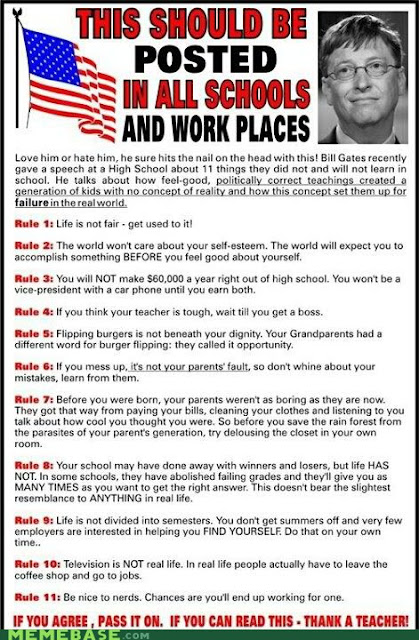
Reality Check, by Bill Gates.

Have you seen this recent meme about a speech by Bill Gates?
odd job, weird job, unusual job, strange job, unusual career, esoteric career, unconventional job, unconventional career, different job, fun job, better job, profession, vocation, occupation, trade, metier, role, job hunt, job search, career change, skills, networking, nine to five, 9 to 5, rat race, work life balance, employee, employer, job seeker, great work, love your work, entrepreneur, Career plan, business plan, livelihood, lifework,  craft, graft, CV, resume, cover letter, job application


I think this chimes with our post What Is A Good Job?


Do you think your expectations have been too high? How has life in the real world turned out for you?

Monday, May 14, 2012

Work. Life. Balance.

Work life balance is a phrase that gets bandied about by all sorts of invested parties in the world of work. Often it is over simplified as meaning the proportion of your time you spend in or at work. Equally though it can mean the proportion of your happiness or wellbeing that is a result of your work. Gradually experts in the field are coming to understand that the way work makes a person feel has a direct impact on their effectiveness as an employee.


Having a purpose in life seems to be a vital part of a healthy life, so it makes sense for work to be part of the fulfillment of that purpose. If career and purpose are well aligned then it easier to be fully engaged in your day to day tasks.


Engaging an employee with the work and goals of an organisation can be the difference between motivating him or her to work hard and be creative and active in moving forward, or them slumping over a desk barely getting the basics done.


Which Kind Do You Have?
How does your manager act?


The job interview is an opportunity for you, the would be employee, to find out if a company promotes staff well being and actively finds ways to motivate workers. Ask what the organisation offers in the way of

  • staff education and training or CPD
  • what opportunities there are to work outside the box of the job description
  • what incentives or chances to move up or around the company structure are offered
  • what staff support is in place to help on the days or in the periods that anything might not be going so well, this includes sickness payment but also if an employee is struggling with workload or being asked to do things beyond their remit.
Find out if these things are done departmentally by individual managers, or if there is a company wide policy that is implemented by the HR department. Think about which system suits you best. What else do you hope for from your bosses?


Tuesday, May 01, 2012

The changing world of work

Work used to be a case of finding a position in an established organisation, working a fixed number of hours on a fixed number of days and staying there for the majority of your working years. Those days are long gone however. Flextime, teleworking, virtual meetings and cyber commuting have made a huge impact on the way we work.


This article from Pick The Brain recognises that the old 8 hour day didn't sit well with normal psychology and was inefficient, and advocates employee centred structuring.


Big Ambition has lots of advice about Digital Careers, describing work at large organisations such as ITV and BT in their IT and business systems sections. There are courses on building Apps and discussions with people who have already success in the digital world. It is aimed largely at youngsters but the information will be of interest to anyone looking to move into information and technology.


Happiness Goal Setting Tip: the Happy Work-cycle
http://www.the-happy-manager.com/goal-setting-tip.html

The idea that happiness should be an indicator of success as much a financial factors is moving into the world of work as well. Originally used by Bhutan alongside GDP to measure how well the country was doing, happiness is becoming a driving force in people's career choices, with some going to far as to quit their jobs to do work that has more personal meaning for them.


Increasingly work can mean spending more time out of an office environment with technology and more flexible employers enabling people to work from home, or anywhere else they choose.


For people wanting to go it alone, traditional sources of loans and capital investment are now joined by Crowdsourcing, websites that connect people with ideas to hundreds and thousands of people prepared to invest small amounts. Kickstarter is one of the largest of these, with links to Amazon, it has raised $7million for one project alone.


The Work Foundation studies the situation that work and workers are in and how policy and the economy affect and are affected by work. Their press releases summarise their findings but the site includes animated graphs of how the world of work is changing, and other tools and research.


Where will your work take you?